
If you are reading this, you are probably trying to work out how to support someone you love through dementia while keeping them in their own home for as long as possible. That is a hard place to be, and looking for information is exactly the right first step.
Dementia care at home is professional support that enables a person with dementia to stay safely in familiar surroundings. It can be a few hours of visiting help each week, or it can be round-the-clock live-in care. With the right support, many people with dementia can stay in their own home for years rather than moving into residential care.
This guide is a starting point. It explains what home care involves, how the main types of dementia differ, how care needs tend to change over time, and how to choose a provider, and it links out to more detailed guides on each. We are VersaCare, a fully CQC-registered live-in care agency, and our aim here is to give you a trustworthy overview, not to sell you anything.
What Is Dementia Care at Home?
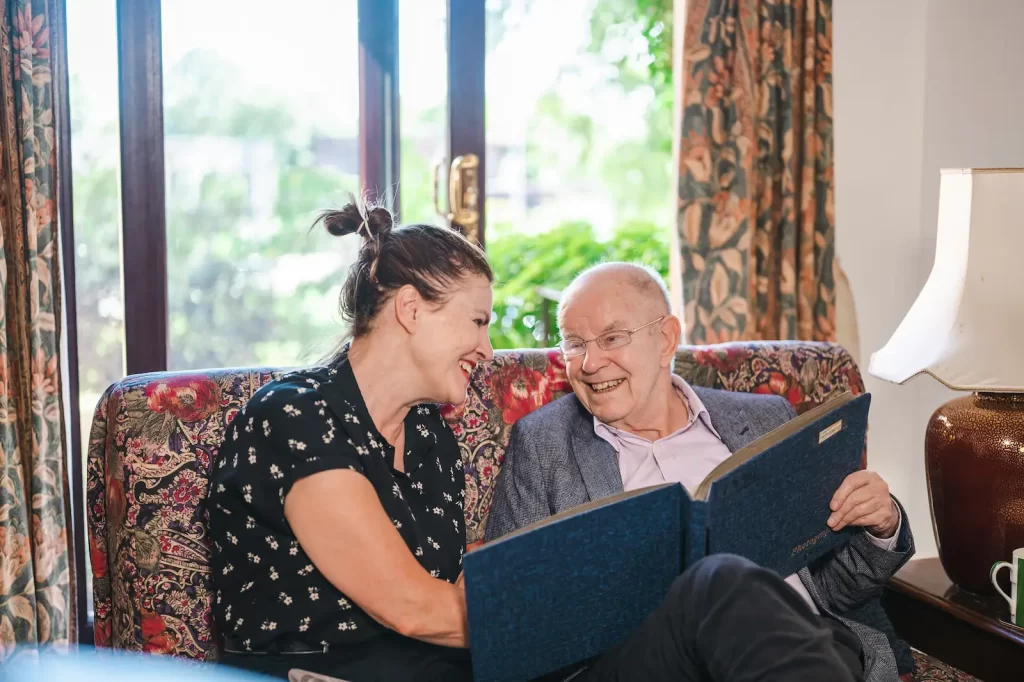
Dementia care at home is personalised, one-to-one support that lets a person with dementia stay in the safety and familiarity of their own home. It can include help with washing and dressing, medication, meals, companionship, and mobility, right through to overnight and live-in care for anyone who needs support around the clock.
Home care in the earlier stages might mean a carer visiting for a few hours a week to help with practical tasks and provide company. As needs grow, it can mean a live-in carer who is present day and night, to ensure safety and continuity with the same carer.
What sets dementia care apart from general home care is the understanding it takes. A good dementia carer knows how to communicate with someone whose words are becoming harder to find, whose actions may be unpredictable. They know how to respond to distress with calming actions, and how to build a routine that helps the person feel settled. Those skills matter far more than the number of tasks ticked off a list.
Why Home Matters for People with Dementia
Home matters because familiarity is one of the most powerful tools in dementia care. Familiar surroundings, a settled daily routine, and steady one-to-one support are the factors most strongly linked to a better quality of life for people with dementia, according to guidance from Dementia UK.
There is a practical reason for this. Dementia does not erode all memory at the same pace. The memory of what happened this morning often fades quickly, while the deeper, instinctive knowledge of how to move around a home you have lived in for decades tends to last far longer. A person may not recall breakfast, yet still find their favourite chair, the kitchen, and the garden with ease.
Move that same person into an unfamiliar building and you are asking a brain that can no longer reliably process new surroundings to do exactly that. The result is often confusion, anxiety, and agitation. This is why NICE’s dementia guidelines ask professionals to weigh up the value of keeping someone in a familiar environment before making changes to their care.
Home also holds a person’s life around them: photographs, well-loved objects, a pet, the view from the window. These are anchors that help someone feel, at some level, that they are still themselves. And when a trained carer takes on the demanding personal care, you can go back to being a loving rather than exhausted relative or carer.
The Main Types of Dementia
Dementia is an umbrella term for a group of progressive conditions that affect the brain, and there are several distinct types. The main ones are Alzheimer’s disease, vascular dementia, dementia with Lewy bodies, and frontotemporal dementia. Knowing which type someone has helps explain why their experience, and the care they need, can look quite different from someone else’s.
- Alzheimer’s disease is the most common, accounting for around 60% of diagnoses according to the Alzheimer’s Society. It usually begins with memory difficulties, particularly for recent events.
- Vascular dementia, the second most common type, is caused by reduced blood flow to the brain and often progresses in a step-like pattern rather than a steady decline.
- Dementia with Lewy bodies is closely related to Parkinson’s disease and can bring detailed visual hallucinations, movement problems, and marked swings in alertness from one hour to the next.
- Frontotemporal dementia is rarer, tends to affect people under 65, and often shows up first as changes in behaviour and personality rather than memory loss.
A person can also have more than one type at once, most commonly Alzheimer’s alongside vascular dementia, which is known as mixed dementia. Because symptoms and progression vary so much, we build our care plans around the individual, not a fixed template.
For a fuller look at each type, how it feels day to day, and what it means for care at home, read our guide to exploring the different kinds of dementia. To understand how the condition develops over time, see our guide to the stages of dementia.
What Does Dementia Home Care Actually Involve?

In practice, dementia home care covers the everyday support a person needs to live safely and comfortably at home. That usually means help with personal care, medication, meals, mobility, and companionship, given in a way that protects the person’s dignity and works with their routine rather than against it.
Here is what a carer typically helps with:
- Personal care: washing, dressing, and toileting, handled gently and with dignity. A familiar face makes these moments far less distressing than they can be with a stranger.
- Medication: prompting, and where trained and authorised, giving medication safely and keeping an accurate record.
- Meals and nutrition: preparing familiar, appealing food and making sure the person is eating and drinking enough.
- Household tasks: keeping the home clean, safe, and comfortable.
- Companionship and activity: conversation, familiar hobbies, and time outdoors, all of which support mood and wellbeing.
- Mobility and fall prevention: supporting safe movement around the home and reducing hazards.
- Overnight and live-in support: reassurance and supervision through the night for anyone who is unsafe or anxious after dark.
One of the strengths of home care is that it grows with the person. A package can start with a few visiting hours a week (with a possible Direct Payment from Social services if financial criteria are met) and build all the way to 24-hour live-in care as needs change, without the upheaval of moving. Some people with dementia also become more confused and anxious in the late afternoon and evening, a pattern known as sundowning, and a live-in carer can offer calm, consistent support through those difficult hours.
Live-in Care and Residential Care: Weighing the Options
Live-in care means a trained carer moves into your loved one’s home and supports them day and night. Residential or memory care provides that support in a care home instead. Both are legitimate choices, and the right one depends on the person, how advanced their dementia is, and what can be managed safely at home.
For many families, live-in care is the option that keeps everything familiar, the home, the routines, and the possessions and faces that anchor a person’s sense of self, while still providing one-to-one support around the clock. A care home offers structured group activity and on-site teams, which suits some people, but it asks the person to adapt to a new environment and a rotating staff team, which can be genuinely hard for someone with dementia.
There is also an important funding difference. When you choose live-in care, the value of your home is not counted in the financial means test. With residential care, your home can be sold once other assets are used up, which means the value tied up in your property can disappear far more quickly. It is also important to note that when assets including property are exhausted then the Council will likely move the client to a Care Home that will accept their funding rate, rather than the one chosen by the client, as it is often far lower. In high property value areas, that distinction matters enormously. Our guides to live-in care costs and NHS Continuing Healthcare explain the funding picture in more detail.
We look at this choice in full, including when a care home is the better fit, in our comparison of live-in care versus care homes, and we make the case for keeping someone at home in our piece on why live-in care is often the better option for dementia.
The Role of Continuity in Dementia Care
Continuity, meaning the same trusted carer rather than a rotating team, is one of the most important factors in good dementia care. Dementia impairs the ability to form new memories and recognise unfamiliar people, so a stranger arriving to help with something as personal as washing can feel alarming, while a carer the person knows and trusts does not trigger that same response.
Continuity also makes the care itself better. A carer who has spent weeks with someone learns their preferences, their routines, and the early signs that something is not right: a change in appetite, a new reluctance to go outside, a dip in mobility, or more confusion at a particular time of day. These are exactly the signals that prompt a timely review, and a rotating team is far less likely to catch them.
At VersaCare, we match each client with a consistent carer and work to maintain that relationship for as long as it benefits the person. Our local Area Managers provide ongoing oversight, so care stays coordinated and any changes are acted on quickly. For families, knowing and trusting the person in your relative’s home eases so much of the worry, especially when you cannot be there every day.
Staying Connected: How Families Can Stay Informed

One of the hardest parts of arranging care is not being there to see how each day goes. Our electronic care reporting is designed to answer that directly. Wherever you are, you can keep up to date with daily care notes covering your loved one’s meals, mood, medication, personal care, and anything the carer wants to flag.
Rather than waiting for a weekly phone call, you can see that your mother ate her lunch, that her medication was given on time, and that the carer noticed she seemed a little more confused this morning. Each small update is something you can act on, and together they take the edge off the constant background worry. We think of this as reassurance, not surveillance, and your local Area Manager is always a named point of contact you can call when something in the notes concerns you. For more on keeping in touch when you cannot be there in person, see our guide to managing care at a distance.
Choosing a Dementia Home Care Provider: What to Look For
When you are choosing a provider, the single most useful starting point is their CQC rating. The Care Quality Commission regulates home care in England and rates providers across five areas: safe, effective, caring, responsive, and well-led. Checking that rating, and reading the full report, tells you far more than any brochure. Our guide to what a CQC rating means explains how to read one.
VersaCare has held a CQC rating of Good, for over 18 years, which means the CQC has always found our care meets the expected standard across all five areas. You can verify this yourself on the CQC’s public register, and we would encourage you to do exactly that with any provider you consider.
Beyond the rating, it is worth asking a provider whether carers receive dementia-specific training rather than just general care training, how carer matching and continuity are maintained, what the assessment process involves before a care plan is drawn up, and whether there is a local manager who provides oversight and someone you can actually reach. The answers separate good providers from the rest far more clearly than marketing does. If you would like to talk your family’s situation through with someone who understands dementia care, you can call us on 0800 0087 661 to arrange a free consultation and assessment. There is no pressure and no obligation.
Frequently Asked Questions
Do Dementia Patients Get Free Home Care?
People with dementia may receive some funded support through their local authority after a care needs assessment, but this is means-tested and depends on both the level of care needed and the person’s finances. Benefits such as Attendance Allowance and Carer’s Allowance may also help. A free consultation with VersaCare can help you understand your options and any entitlements, including Direct Payments for the times that are deemed to be sufficient by Social Services, with a top-up by family to provide the Live-in Care that is preferred. We can also help in getting re-assessments as the severity of the dementia progresses and care needs increase.
What Is the 90-Second Rule for Dementia?
The 90-second rule refers to the observation that an emotional response, such as distress or anger, usually peaks and begins to subside within about 90 seconds if it is not re-triggered. In dementia care, it is a practical reminder: if someone becomes upset, stepping back and giving them a little space, rather than pressing the point, lets the emotion pass more naturally.
Should You Let Someone with Dementia Sleep All Day?
Sleeping more can be normal in later-stage dementia, but a big increase in sleep during earlier stages may point to illness, medication effects, or depression, and is worth raising with a GP. A structured daily routine, with time outdoors, gentle activity, and social contact, helps keep sleep patterns steadier. A live-in carer is well placed to build and maintain that routine day after day, which is often what makes the difference.
How Do I Arrange Dementia Home Care?
The usual first step is to request a care needs assessment from the person’s local authority social services, which identifies what support is needed and whether any state funding is available. You can also approach regulated private home care providers directly. A good provider will carry out its own assessment before drawing up a care plan. VersaCare offers a free care consultation on 0800 0087 661 whenever you are ready to talk.
How Do You Deal with a Dementia Patient Who Refuses Care?
Refusal of care is very common, especially with personal care, and it usually comes from confusion, fear, or a sense of lost control rather than deliberate resistance. What tends to help is never forcing care, explaining each step simply before you begin, offering small choices to restore a sense of control, and using gentle distraction. Above all, a trained, consistent carer who has built a trusting relationship is far more likely to be accepted than a stranger. Our guide to understanding the reasons behind refusal of care goes into this further.